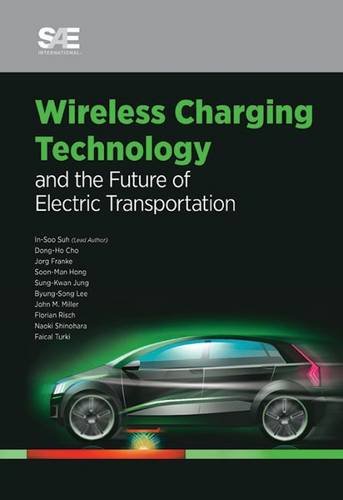
"Nikola Tesla's Wardenclyffe Tower experiment in Long Island in the early 1900s, the transmittance of electricity from a source to an electric device without a wire or cord has been pursued for more than a century. While current automotive industry is focused on developing static wireless charging of electric vehicles for plug-in hybrid or electric vehicles with the delivering capacity below 7 kW ranges, a few prototype technologies are demonstrated with dynamic wireless charging capabilities with more than several 10 kW ranges. One example described in this book is the historic public launch of a people mover vehicle in Seoul Grand Park, Korea, with dynamic wireless charging capability, which was led by Dr. In-Soo Suh, the principal editor of this book. Around the world, the major automakers are developing their strategies for conductive and wireless charging technologies, with concerted efforts to establish technical standards on wireless electric vehicle charging, mainly focused on the safety considerations and inter-operability"-- Provided by publisher.
SAE order number R-444.
Introduction
Introduction to wireless power transfer technology
Wireless power transfer in transportation
Micro mobility and wireless power transfer
Structure of the book
References
Green transportation and electric vehicles
Future automotive power drive trend
Intelligent transportation system
Electric vehicle charging systems
WPT application to EV
Implications of wireless charging in future transportation
References
EV charging technology: conductive and wireless
Conductive charging
Wireless charging
Commercial WPT technologies
Rollout of wireless charging
References
An overview of OLEV technology
Background
SMFIR technology
Overall system
Design of power supply infrastructure
Design of power collection systems
Application of SMFIR technology to bus
Application of SMFIR technology to train
References
Wireless power transfer technical issues and challenges
Vehicle to infrastructure communications
Alignment to primary charging pad
Challenge of gap variations
Control of charging process
Obstacle detection
Emergency shut-down
Normal shut-down
Electrical safety: high-frequency isolation transformer
Emission
Grid connection power quality
Installation and commissioning
Summary
References
Markets, strategies, and standards in EVS with WPT
Introduction
Optimization problem for WPT in electrified vehicles
Simulation approach to determine an optimized WPT infrastructure design
Fields of application for fleet-operated vehicles using WPT systems
Conclusions
References
Wireless charging of consumer electronics in the automotive industry
Wireless charging of consumer electronics
Design considerations
Wireless charging in automotive applications
References
Railway application of WPT
System overview of railway application of WPT
Track segment switching
Metro and light rail applications
TRANSRAPID Maglev train
Light rail application
Wireless low-floor tram
References
Long-distance power transfer
Introduction
History of long-distance power transfer
Theory of long-distance power transfer
Recent applications of long-distance power transfer
Conclusions
References
Industrial applications of WPT
System overview
Crane applications
Automated guided vehicles
Skillet conveyor
Transfer car
Electric monorail system
Sorter technology
Clean-room technology
Elevator systems.
OBNB doesn't sell books, but you may be able to find a copy at one of these websites:


Wireless charging technology and the future of electric transportation. ISBN 9780768081534. Published by SAE International in 2015. Publication and catalogue information, links to buy online and reader comments.